
Who We Are?
History
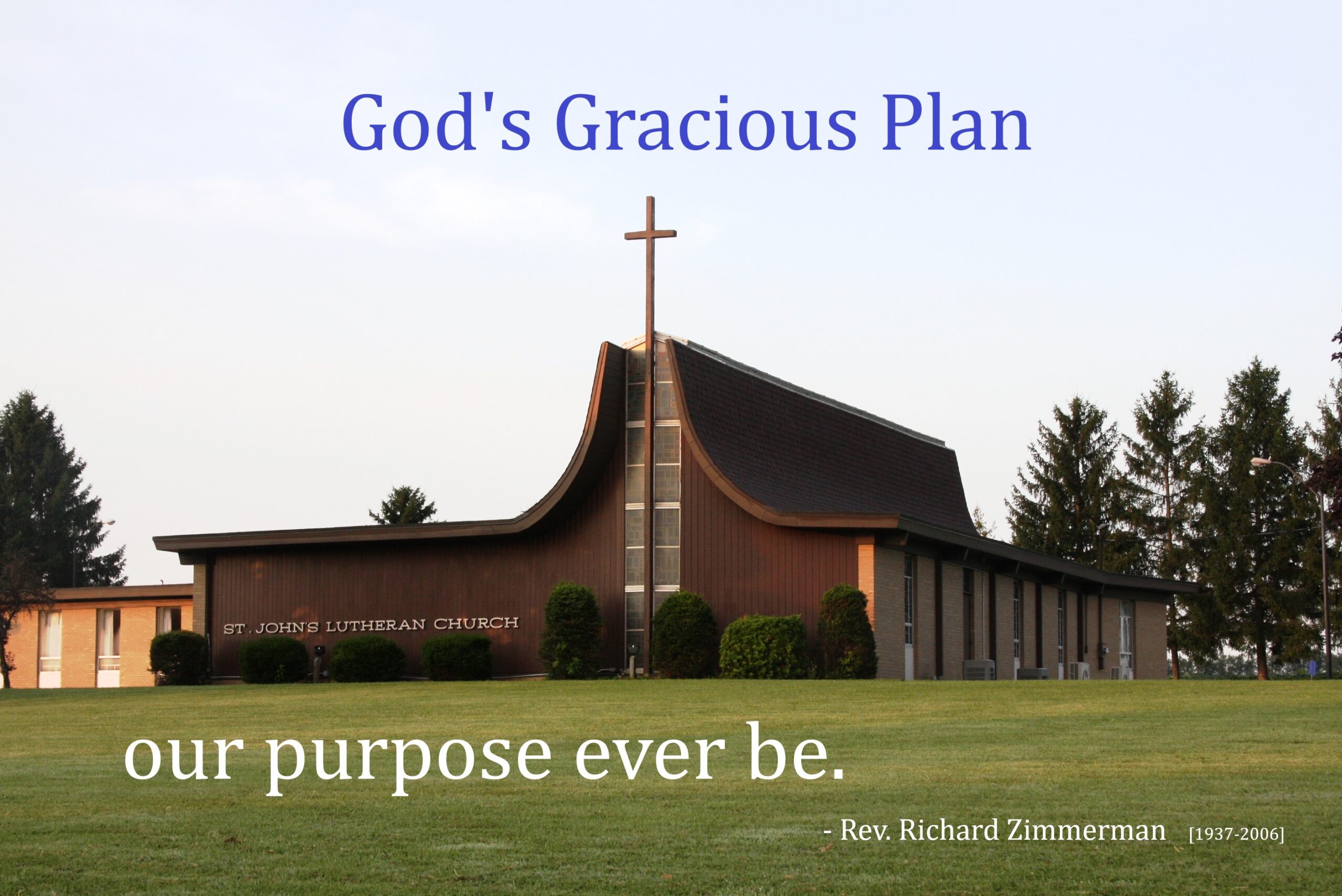
The first service was held on June 20, 1965 under the leadership of Pastor Zimmerman. He was pastor from 1963 until 1968.
Pastor Zimmerman had written a hymn (using a familiar traditional tune) that has been sung every year when celebrating the congregation’s anniversary.
A BRIEF HISTORY OF ST. JOHN’S LUTHERAN CHURCH DELAWARE TOWNSHIP MERCER COUNTY PENNSYLVANIA
1837-1987
Written by Paul Stoyer and Norman Cochran
The land that is now Lawrence and Mercer Counties in Pennsylvania did not become secure for settlement until 1795 when General Anthony Wayne won a decisive battle with Indians in Western Pennsylvania. Immediately following the opening of these lands, settlers came in ever-increasing numbers to make homes in the vast wilderness which contained forests and swampland. The earliest settlers were mostly Scotch-Irish homesteaders. In 1796 some of the first German families began creating their homes from this forested land. The German families were in widely scattered areas which made it difficult for them to assemble in congregations or to be given ministerial services from Lutheran and Reformed pastors who occasionally came to this area.
Life for these pioneer families was often difficult, often short, and always uncertain. Because there were no roads but only a few tracks or paths through the dense forests and swamplands, communication was infrequent among the families living in those isolated homesteads. The German-speaking families did not often come in contact with their English-speaking neighbors and therefore continued to maintain their culture long after their homes became secure. How eagerly they must have awaited the occasional visits from the traveling pastors who came into this remote land to minister to them.
In 1805 the Rev. Michael Steck, a visiting Lutheran pastor from Greensburg, Pennsylvania held services for the families of Jacob Keck, Jacob Loutzenhiser, David, Peter, and John Klingensmith in what is now West Salem Township. The following year Pastor Steck held confirmation services for this settlement. His last recorded visit was in 1812 when he baptized the child of Mr. and Mrs. Abraham Keck.
By 1807 the above mentioned families along with others living in the area four miles south-west of Greenville were able to unite and organize Good Hope Lutheran Church with the assistance of the Rev. Johannes Stauch, a Lutheran minister. Their church was one of the first, if not the very first Lutheran church in Mercer County. Later this church came to be referred to as the “Mother Church” of St. John’s Lutheran Church. The fledgling congregation had no building of its own for nine years and no regular pastor, but they were a church nonetheless. In 1815 they gained their first regular minister, the Rev. Heinrich Huet, who made arrangements to serve them every four weeks. He continued with them until 1827 and during this period a site for a church was donated by Peter Klingensmith and Jacob Keck. Today that site is a peaceful looking area on Cemetery Road just off what is now the Good Hope Road, west of Route 18. It was 1816 before the congregation could build their first church, a twenty-six foot by thirty foot log structure. Also there was land available for an adjacent cemetery which is still in use, its old grave markers a quiet testimony to its age. On May 2, 1869 a corner stone was laid for a new frame church to replace the log “first church”. This new structure was thirty-five by fifty foot and cost three thousand dollars, which at that time represented a considerable offering. This frame structure was eventually moved to a location in the village of Shenango at the end of Washington Street where it continued to serve the congregation until 1948 when the building was sold to another congregation, Church of Christ. The graceful, old building is still in use as a church and is well maintained.
Living in the area near what is now the historic Red Brick School Building in Delaware Township were Lutheran German-speaking people who traveled over to Good Hope Lutheran Church for services. The distance between the church and their homes caused quite a hardship for these families, especially in periods of harsh weather. For this reason these families, with the help of their pastor, the Rev. Michael Kuchler, decided to form another congregation and hold services closer to their homes. Pastor Kuchler who traveled throughout Mercer County organizing and serving churches, continued to be their minister as well as continuing to serve Good Hope. Soon the German-speaking Reformed families who were living nearby in Delaware Township joined the Lutherans in their worship services until a Reformed Church could be constructed. This was not an unusual practice in the first half of the 19th Century; a single log church often served a large territory where the inhabitants were of the same culture, although of different denominations.
On January 1, 1837, a meeting was held to organize a union church and elect officers for both the Lutheran and Reformed congregations. To the Lutheran Church council were elected George Hittle, Jacob Kaufman, Peter Gebel, and Daniel Steiger. (Steiger is the early German form of Stoyer.) The Reformed congregation elected Isaac Siegfried, Trustee and Benjamin Moyer, Deacon. One year later Daniel Hecker was elected Elder and Peter Waugaman was elected Deacon by the Reformed congregation. Nearly all of the people who partook of the first Communion May 14, 1837 were former members of Good Hope Lutheran Church.
St John’s Church, following its organization as a union church in 1837, started to worship in this area in a log building 24′ X 30′ which was erected at a cost of approximately $60.00. This church building was dedicated the same year and was erected on or near the now historic Red Brick School. On March 23, 1838, the two congregations gained an acre of land for $10.00 which was deeded to Isaac Siegfried and Daniel Steiger in trust for the church for a building site by Mr. and Mrs. John Haas. The property was located at the corner and east of the Mercer-Greenville Road across from the former Log Church. Because of this gift the church built on this site was informally known as ‘the Haas Church on the corners.’ This new church which had been built to meet the needs of the growing community and the two congregations was modeled after the type of old Westmoreland Churches with a gallery around three sides and a high pulpit at one end above the altar. There were four donations of land at different times including one on which sheds were built to offer protection for horses and buggies. Adjacent and to the east of this new church built in 1846 ground had been previously set aside for St. John’s Cemetery which to this day displays grave markers dating from the late 1830s and early 1840s. A soldier, John George Leisher (Lischer), who served in Napoleon’s Army, is buried here as are the donors of the land and others from those pioneering days.
The two congregations continued to worship in the same building until the mid-20th Century; their records were kept in the same book until 1887 and all ministerial acts and services were conducted in German until just prior to World War I. In 1865, Good Hope Lutheran Church and St. John’s Lutheran Church applied for admission to the Pittsburgh Synod.
After seventy-five years of use, the frame church with its three-sided gallery was moved back on its land and remained in use while a new brick church was being built. The new brick building, which is still owned and used by St. John’s United Church of Christ, was constructed of tapestry brick and stone and is easily visible to travelers along the Greenville-Mercer Road. The church was complete and ready for dedication on Sunday, October 30, 1921 with services throughout the day. The fifty thousand dollar ($50,000) construction cost was subscribed by the congregation and at the time of dedication the church was free of debt. 1921 was the year that the Greenville-Mercer Road was paved which made it possible for year round travel by auto, a fact much appreciated by the people living in Delaware Township. Eight-four years earlier, members of this congregation had found it difficult to travel by horse and buggy over dirt roads to Good Hope Lutheran Church. No doubt there were many in 1921 who could remember hearing their parents and grandparents telling of those trips to and from church.
During October 18-25, 1936 the two congregations celebrated their centennial year. There were thirty-eight members who had belonged to the church for fifty or more of those one hundred years, some of them direct descendants of John and Sarah Haas, donators of the land on which their church was built.
At one time St. John’s Lutheran Church was one of four Lutheran congregations in its parish. Good Hope, in West Salem Township, was organized in 1807; St. John’s, Delaware Township, organized in 1837 as a union church; Zion in Pymatuning Township (Rickert Church), organized in 1854; and Salem Lutheran in Otter Creek Town ship which was organized in 1881 and merged with Holy Trinity of Greenville in 1923. Of these four only St. John’s still exists.
By 1957, after one hundred twenty years of joint worship, it became apparent to many that the time had come for the two congregations to separate. Their common culture and the isolation of their scattered homesteads had made the joining of the two denominations a natural thing in the first half of the 19th century, but by the mid-20th century living conditions were very different. Everyone spoke English and good roads, cars, telephones, radio and television insured that there were no isolated homesteads in Mercer County. The differences in their religious traditions, which had always been there, became more noticeable as the two congregations strove to expand their programs in order to better serve their members in their respective religious traditions. Therefore in 1958 a joint committee was formed that ultimately recommended that the two denominations work toward separation. After debating the issues over the next few years, simultaneous meetings were held in July 1962 by the two congregations. These meetings resulted in a decision: the United Church of Christ congregation would remain in their present church building and the Lutheran congregation would move out, using the forty-three thousand two hundred dollars that was agreed upon as their portion of the previously shared property to help finance a new church and its land. The Lutherans then agreed to pay rent for the continued use of the church building until they could move into their new structure. The official signing of the Articles of Agreement took place on January 1, 1963.
After some discussion the six acres one and one half miles north of the original St. John’s on the Mercer Road, known as the Sapala property, was chosen over the McKean property located on the east side of Route 58, across from Wasser Bridge Road. The Lutheran congregation paid eight thousand one hundred seventy-eight dollars for the site of the proposed new church building in September 1963. (An interesting parallel can be drawn between the selection of the Detmar property in 1838. The Detmar property was located about one half mile from Beil’s Cross Road, now called Oniontown Road. In both periods there was some division of opinion concerning the selection of property sites.)
Ground-breaking services were held on year later, October 1964. The Johnson and Sizer Company was hired as the general contractor for the building designed by the architectural firm of A. Robert Brooks of the Dollar Title Building in Sharon, Pennsylvania. Dale Redfoot, a former member of St. John’s Lutheran Church and son of Orpha Redfoot, was an associate of that firm. The building was completed at a cost of $161,565.00.
Sunday, June 20, 1965 stands out as a landmark day for St. John’s Lutheran Church for it was a moving day, a day of ambivalent feelings and special events. The first event was the final joint service with the St. John’s United Church of Christ; later that day a service was held for the dedication of the new church which was attended by two hundred fifty people. It would be another week, June 27, 1965, before the first service would be held in the new church and that following a long night of preparation, making ready the furnishings of the church.
The twenty-two years since St John’s Lutheran Church has had its own building have brought growth and changes. It was during this period that the make-up of the congregation shifted from being largely an extended-family congregation to one comprised of a mixture of related families and many new members whose work brought them to this area.
In 1976 we were proud to have Emery Barnett be our first congregational son to enter the ministry from St. John’s in 139 years. Emery is the son of Mr. and Mrs. Willis Barnett.
The Lutheran Church has always been interested in education. The first Sabbath School in this area was organized by Samuel Webster, a school teacher, in 1817, near Upper Salem Church, Delaware Township. It was considered very radical at the time, however, because the Sabbath Day was set aside for worship and many believed that school was too secular for a Sunday. The Sabbath School was established to help children understand the Bible, Catechism, and the hymn book. The departmentalized Sunday Church School of today which includes classes for children three and four years old to classes for adults developed from the Sabbath Schools.
St. John’s Lutheran Church has been especially fortunate to have had very able ministers beginning with the Rev. Michael Kuchler, who in 1837, helped the people of Delaware Township area form their own congregation, and served two terms as their pastor for a total of eighteen years. St. John’s ministers have served us as worship leaders, spiritual leaders, teachers, and as providers of pastoral care. They have shared our joys and our sorrows; they have been our friends.
In our more recent history and within the memory of many of our members are:
The Rev. Wilson Yeisley who is remembered as well-liked and easy-going. He was often paid by donation by members to augment his modest salary. Farm produce, food and grain for his family and horses were commonly supplied. This was a common practice at the time.
The Rev. Charles E. Schweikert instituted the tradition to “forgive” the congregation’s debts each New Years’ meeting, involving the unpaid portion of his salary. He set an impressive example for Christians in the Great Depression years. He placed emphasis on unity among Christians and stressed the importance of tolerance of other Christian traditions. Along with Pastor Yeisley, Pastor Schweikert is remembered as a “grass roots” Christian who taught by the example of his life. These men are remembered as having been effective pastors who taught values of Christianity through the lives they lived. They were role models for Christian life.
The Rev. J.C. Klingensmith was more strongly tied to the Synod and established a stronger commitment of St. John’s Lutheran Church to the regional and national/international mission of the Lutheran Church. He helped guide the congregation in the period just before the separation.
The Rev. George Reese, although an interim pastor and not with us very long, is well remembered as an effective role-model of Christian life. His ministry was in the style of Pastors Yeisley and Schweikert, but with much more attention to the world mission and larger social responsibilities of Christians.
The Rev. Richard Zimmerman was more formal than earlier pastors had been and shared the commitment to national and international Lutheran Church mission. It was he who was our pastor when we moved into our present church building and for three years afterward.
The Rev. Theodore R. Hildebrand possessed a profound theological perspective which enabled him to emphasize tolerance of diverse views, positive attitudes, and respect for each individual’s worth. He encouraged wide-spread participation in congregational life and in worship services. At the same time his ministry emphasized the work of the church in the world.
The Rev. Ronald L. Harbaugh, who has just taken up his ministry among us, is welcomed with enthusiasm.
A church is its people; not merely the building and land upon which they rest. Although quite a few of us at St. John’s Lutheran Church are actual descendants of early members of our church, we are all the spiritual descendants of those early German inhabitants of an outpost, pioneer society. After one hundred fifty years of faith and life, we look forward to the future with faith and hope.
Lutheran Church in Mercer County and Greenville
-from an 1875 interview with Pastor Kughler by the Shenango Valley Argus
It seems that previous to 1814, the German settlers of Mercer County had no regular minister, but were occasionally visited by pastors who were sent by the Synod to preach the Word and administer the Sacraments to the scattered members of the Lutheran and Reformed churches. In 1814, Rev Henry Huet (the name is now spelled ‘Hewitt’), a member of the Lutheran Pennsylvania Synod, began to preach regularly, every four or six weeks, at points where the Germans were most thickly settled. In 1817, a Conference was organized, embracing the Lutheran Pastors west of the Alleghenies, and among them were Revs Jno Stouch, Meyer, Weygand, Snyder and M. Steck. In 1814, Rev Huet preached in Wolf Creek township. In 1825, Zion’s church was built, now one of Rev. Dieffenbacher’s preaching points. During the same time, Rev Huet preached at Harlansburg, in Mercer County. Six miles beyond Harlansburg, another of his preaching places was at Herbst’s. The people met for worship, as the season allowed, in groves, private houses or barns. Good Hope, (Coal Hill) West Salem township, was also supplied by Rev Huet. In the early part of 1826, through Rev Huet’s removal, these places were unsupplied. November 26, 1826, Rev M. Kughler took charge of the Herbst’s congregation in Lawrence County; in 1827, of the congregation in Wolf Creek township and of Good Hope, and in 1828, in Hickory township, of the Everhart church; preaching also at Pulaski, Brookville, O., Krill’s and other places. In Hickory township at Everhart’s, no church was built until 1837. At Good Hope, under Rev. Huet, in 1816, a log church, 26X30, had been erected. Blocks and rough boards were used as seats until under Rev. Kughler, Mr Jacob Hahmm (now spelled Hum) furnished the church with pews. Peter Kilngensmith and Joseph Keck (the fathers of Messrs. John and Henry Keck) were most active in securing the erection of the first Good Hope church. At St John’s, (the Haas’ church) a log building, 24X30, was erected in 1837; the members of this organization, having worshipped up to this date at Good Hope. In 1824, Rev. Kughler resigned the Herbst’s church which was then supplied by Rev Hoelsche. In 1839, Rev Kughler removed to Erie and the churches were again vacant. Rev T. Becker succeeded Rev Kughler, remaining some seven years. In 1846 at St John’s (Haas) a new church edifice, 35X45, and of two stories, was erected. With the close of 1847, or beginning of ’48, Rev Theo Hengist became the successor of Rev Becker. He was succeeded by Rev G. Krantz. In 1858, Rev Kughler again took charge of the field, preaching at Blacktown, 21 miles from Greenville, on the second day of 1859 and thence to 1864. In 1861 he served also, St John’s, Good Hope, and the church in Hickory township. Rev J. Hengist had preached statedly to the Germans of Greenville for some time previous to 1859, in the Congregational Church. On Easter Sunday, 1859, Rev Kughler conducted his first service in the same place, and for some years afterward every other Lord’s Day P.M. Rev Hartman purchased for the German Reformed, the old Congregational Church in 1863, and the Lutherans held services in the old school house and for some time in the Baptist Church. In 1859, under Rev Kughler, a German Lutheran church was organized with C. Bittenbanner and Jacob Beitler (now both deceased) as elders. In 1863, Rev W.F. Ulery was appointed traveling Missionery of the Pittsburgh Synod of the Lutheran Church. He came to Greenville in his missionary work, and after preaching some time removed his family thither in 1864. The building of a church was soon determined upon. On September 23, 1865, the corner stone was laid. Rev W.A. Passavant, G.A. Wenzel, H.W. Roth, M. Kughler and Pastor Ulery taking part in the services. In October 1867, during the meeting of the Pittsburgh Synod, the building, which had been already used for public worship for some months, was formally dedicated. In 1871, Revs. Ulery, and Roth, both being connected with Thiel College, were co-pastors of the congregation. After Rev Ulery’s resignation in April, 1875, Rev. H.W. Roth was called to the pastorate of the Church of the Holy Trinity.
The statements above given have been secured through the kindness of Rev Kughler, now over his three score and ten but with wonderful vitality and clear memory. We regret that the very limited time at our disposal and the absence of the necessary documents prevent our furnishing names and statistics which would much add to the historical value of this hasty sketch.